
Making the Map Matter
Part 5 of the Working Desk: How AI Helped Me Design Locations That Erase History

TL;DR
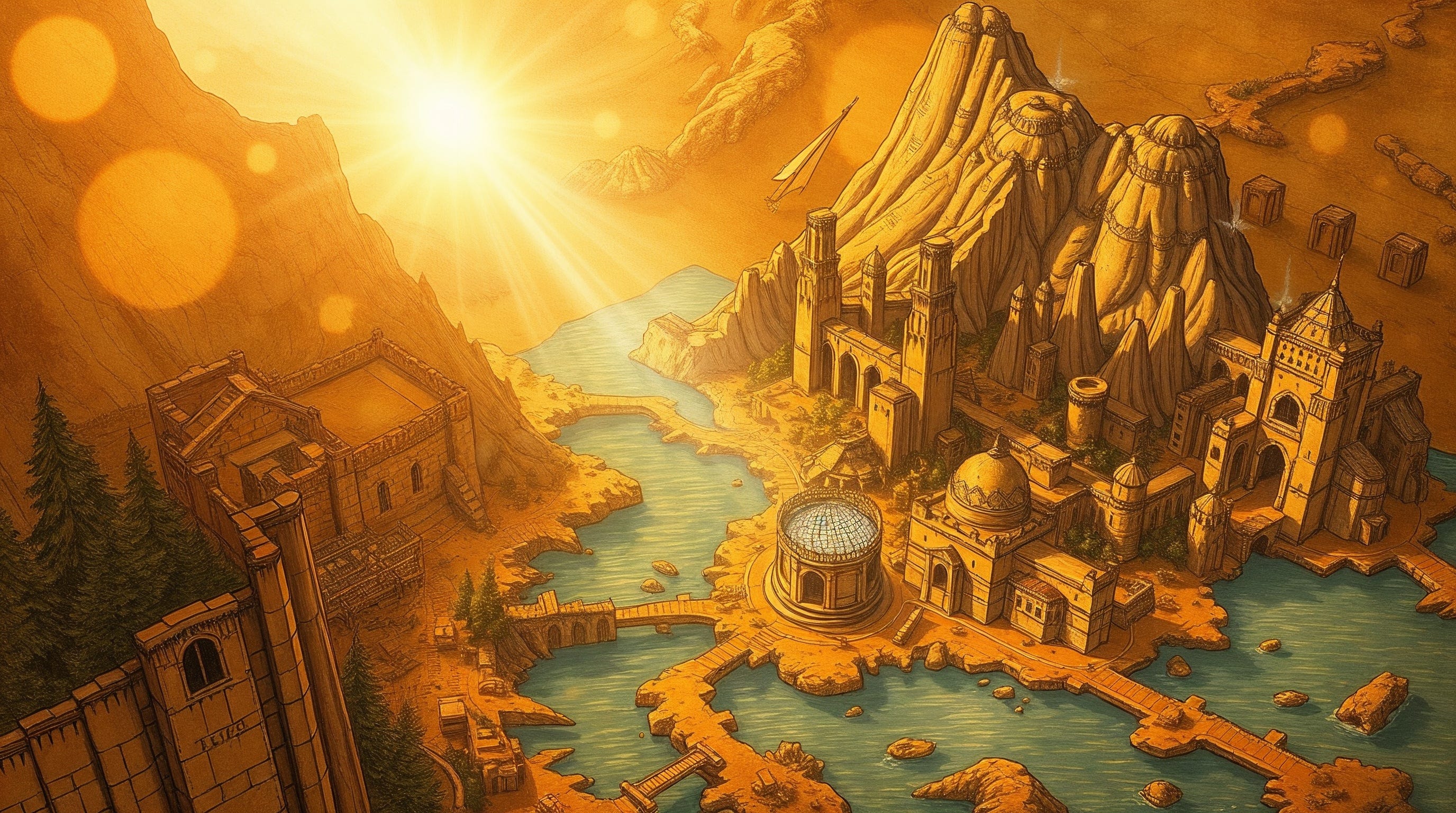
This week, I shifted from big-picture structure to world specifics: key locations. The challenge was to avoid generic fantasy settings (The Shady Forest, The Sparkling City) and make every place a tool for the trilogy’s core themes—erasure, control, and inherited complicity. The breakthrough was moving from “What does this place look like?” to “What did this place replace?” By modeling locations after real-world systems of control and buried atrocity, the map became sharper, more emotional, and part of the lie itself.
The Trap of the Generic Map
The Root of Memory has always circled one question: When lies shape reality, what would you risk to remember what’s real? Plot and characters alone weren’t enough—setting had to ask and answer this question, too.
I didn’t start by reaching for fantasy clichés, but the original draft came loaded with forests, fortresses, ruins—all the usual suspects. These weren’t inherently bad, but they felt empty: the map was functional, not meaningful. Who controls memory here? Who decides which stories survive? The world offered locations, but not the right questions.
In this story, a setting isn’t just scenery—it needs to be a physical manifestation of the trilogy’s themes: control, suppression, and systemic oppression. A forest isn’t just ancient and spooky—it’s haunted by what it’s been forced to forget. A city isn’t only tall and sparkling—it sits atop forgotten crimes.
Breaking Free from Decorative Settings
To break from the generic, I started by cutting the obvious tropes. “Does the world really need another volcano or generic dead forest?” became my refrain.
The early brainstorming, even with AI’s help, churned out variations on the same fantasy themes: spires, groves, halls, and withered woods. It was detailed, even atmospheric—but it didn’t bring me into the story’s heart. An example: The Witherwood, a dead forest where every tree once held a forgotten name, was visually compelling but only scratched the surface of what erasure really means.
I realized that the challenge wasn’t creating new shapes on a map—it was charging those shapes with significance. It wasn’t about the forest or city as objects, but as battlegrounds for memory and meaning.
The Breakthrough: Location as Systemic Oppression
What finally unlocked the map was a change in the question itself. Instead of asking “What does this place look like?” I started asking, “What did this place erase or replace?”
I challenged myself to root every important setting in the real world’s history of conspiracy, manipulation, and oppression. The result: each fantasy location drew direct inspiration from a real site of erasure or control. For example, Caretaker’s Grove—the starting point for the trilogy—found new life when modeled on Greenwood, Tulsa (Black Wall Street). Once I anchored the Grove in the real story of a thriving Black community erased from public memory after racially motivated violence, the fictional landscape felt newly alive and tragic.
Now, each place actively participates in the story’s themes. The map isn’t just a convenience for characters to traverse—it becomes an archive of what power tries to bury, and a crucible for the lies characters must confront.
How This Changes the Writing
Visualizing these locations together, not just as fantasy terrain but as echoes of real-world trauma and resistance, changed my approach to every scene.
When Bram enters the Caretaker’s Grove, he’s not just walking through an enchanted forest—he’s stepping into living memory, surrounded by the weight and stubborn rebirth of what others tried to erase. When Lilla moves through the Fire-Washed Districts, she’s not just seeing city streets; she’s passing through a legacy of systematic forgetting woven into daily life.
This was a reminder that beautiful or detailed settings aren’t enough. What matters is their power to remind, resist, and accuse. In tying every location to real-world struggle, every moment in the story now carries the trilogy’s full thematic weight.
What’s Next
Now that the stage is set with a map that remembers—and resists—the next work is with the characters: building them as products and challengers of the world’s truths and lies.
Next week: how Lilla and Bram were shaped (and reshaped) to wrestle with the burdens and blindspots their world hands them.
Question for readers: What real-world system of control or oppression—historical or current—do you find most challenging to translate into fiction without losing its true emotional weight? I’d love to hear your thoughts in the comments.
Your map isn’t just lines and symbols. It’s what the world wants you to forget—hidden, recovered, and made dangerous all over again.
Free subscribers get additional details, prompts, and downloadable content!
Today’s Books!
The Balance of Shadows
Balance is Broken: Discover the Untold Truth Behind Light and Shadow.
A fantasy prequel where forbidden energies spark rebellion

For centuries, the world’s balance has depended on the strict division of light and shadow. Those born with light energy thrive under the sun, while those tied to shadow linger in darkness, bound by laws that claim separation is the only path to harmony.
But when an ancient truth resurfaces, it reveals a dangerous secret: light and shadow were never meant to be divided. As forbidden magic stirs and long-held beliefs crumble, two lives collide in a moment that will change everything.
The fragile balance begins to fracture, and whispers of rebellion grow louder. In a world built on lies, the truth could cost everything—and ignite a spark that threatens to consume them all.
Perpetual
Two people separated by class in a place where class is determined by body weight
An enemies to lovers post-apocalyptic dystopian teen romance

What happens when a future Romeo and Juliet stand up against the polarized dystopia their parents and grandparents are building?
Unable to settle for stolen moments, these deviant enemies-to-lovers dare to oppose the status quo, defying the strict, unjust rules of an invisible, self-serving system that a corrupt and incompetent regime imposes on them.
What happens when this rebellious Romeo and Juliet break the social machine that puts food on the table and water in the faucet? Can they do better?
A post-apocalyptic dystopian science-fiction romance.
The Survivors
A struggle for the fate of humanity
The prologue to the Defiant Space books

In this tale of space opera and cosmic adventure, the Ambassador of a mysterious and ancient family must forge a path through chaos to overcome the terrible enemies that desire humanity’s destruction.
Her plan to avert galactic catastrophe will unite a band of survivors who have faced every imaginable danger and disaster.
This story forms a prologue to the Infinite Void series.